|

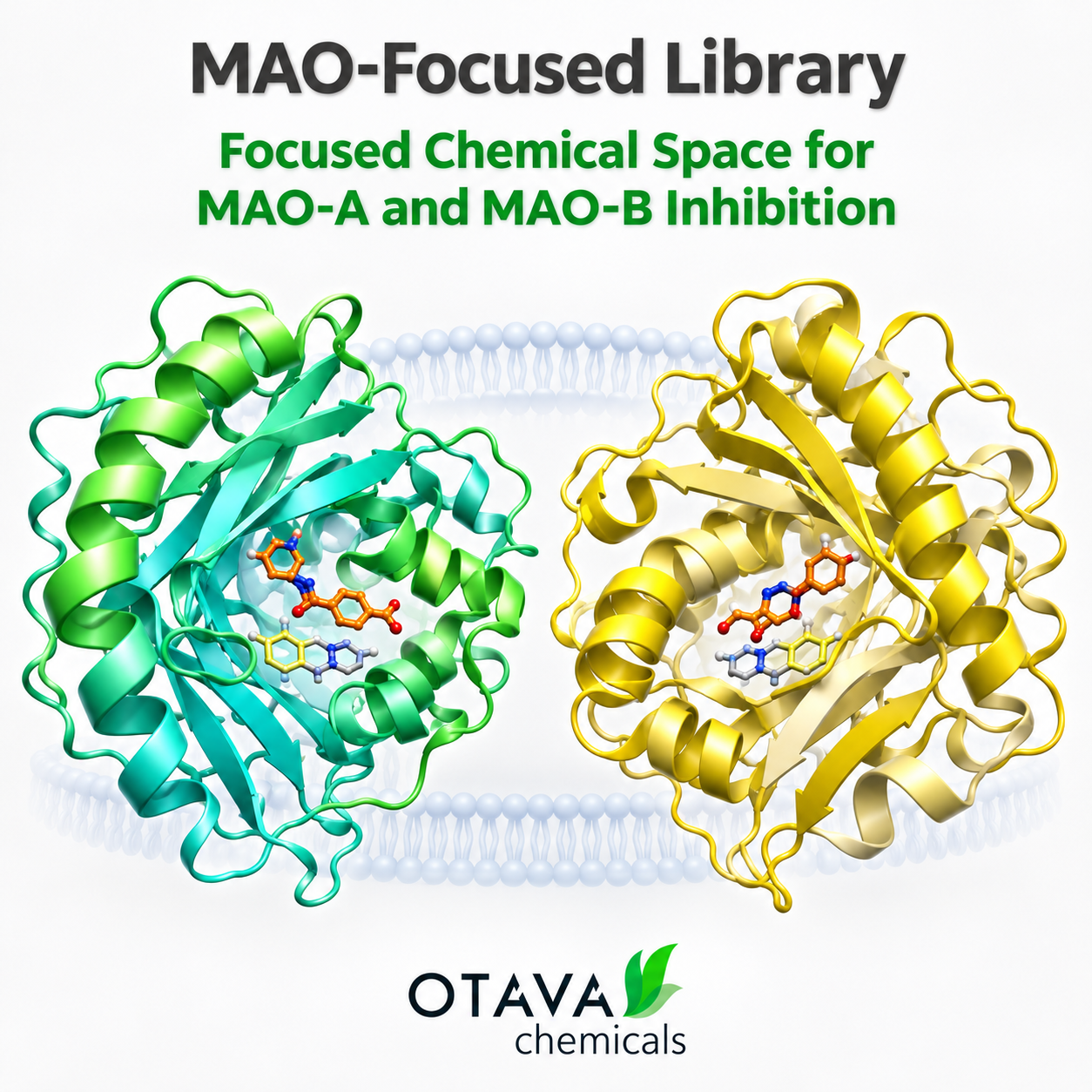
Monoamine oxidase (MAO) is a flavin-dependent enzyme of the outer mitochondrial membrane that catalyses the oxidative deamination of biogenic and dietary amines. Its two isoforms, encoded in humans by the MAOA and MAOB genes, differ in substrate preference and tissue distribution: MAO-A preferentially metabolises serotonin, noradrenaline and adrenaline, whereas MAO-B acts mainly on phenylethylamine and benzylamine and, together with MAO-A, on dopamine. By controlling the turnover of these neurotransmitters and generating hydrogen peroxide as a reaction product, MAO influences both monoaminergic signalling and oxidative stress in the central nervous system.
The therapeutic relevance of MAO spans several disease areas. MAO-B inhibitors are established agents in Parkinson’s disease and are investigated in other neurodegenerative conditions, while MAO-A inhibitors have a long history in the treatment of depression and anxiety disorders. Isoform selectivity, reversibility of inhibition and multi-target profiles combining MAO inhibition with other neuroprotective mechanisms remain active directions of medicinal chemistry research [5].
The OTAVA MAO-Focused Library was developed using a data-driven ligand-based workflow in which the reference set was derived from in-stock compounds with documented MAO activity rather than assembled manually, and then used to search the OTAVA compound stock for structurally related molecules.
The following computational approaches were employed during the library design process.
1. Reference Set Derived from Annotated Bioactive Compounds
The reference set was extracted from the OTAVA Annotated Bioactives Library, a collection of in-stock compounds carrying curated bioactivity data from the ChEMBL database [1]. Compounds were retained only if they were reported to inhibit human MAO-A or MAO-B with a potency of 1 µM or better in binding or functional assays of high target-assignment confidence, drawn from the peer-reviewed literature and other curated sources.
This procedure yielded 84 experimentally characterised MAO inhibitors available from stock, spanning distinct chemotypes associated with MAO inhibition:
-
coumarins — including 3-carboxylated and 7-substituted derivatives
-
chalcones and related α,β-unsaturated ketones
-
xanthones and oxygenated polycyclic scaffolds
-
isatins and related oxindoles
-
benzamide-type reversible inhibitors of the moclobemide class
Because the reference compounds originate from the stock itself, each of them is available for direct experimental comparison alongside the compounds selected around it.
2. Molecular Representation and Similarity Screening
Structures were standardised with the ChEMBL Structure Pipeline [2], which reduces salts and solvates to their parent forms, and each compound was then encoded using Morgan fingerprints (ECFP4, 2048 bits) [3], capturing its structural features as circular substructure patterns.
Tanimoto similarity was computed between every stock compound and each reference inhibitor, and every molecule was assigned the maximum similarity to its nearest reference compound. The full OTAVA compound stock, comprising approximately 300,000 small molecules, was screened in this manner.
3. Similarity-Based Selection
Compounds were prioritised according to their maximum Tanimoto similarity to the reference inhibitors. A similarity threshold was applied to retain molecules with meaningful structural relatedness to experimentally characterised MAO chemotypes while excluding structurally unrelated compounds.
For every selected compound, the nearest reference inhibitor, its ChEMBL identifier, its annotated MAO isoform and its reported potency are recorded in the library files, so that each entry carries an explicit link to the experimental data that motivated its selection.
4. Drug-likeness Filtering and Quality Control
The similarity-selected compounds were filtered using Lipinski’s Rule of Five and related physicochemical criteria:
-
Molecular weight ≤ 500 Da
-
LogP ≤ 5
-
Hydrogen bond donors ≤ 5
-
Hydrogen bond acceptors ≤ 10
-
Topological polar surface area ≤ 140 Ų
-
Rotatable bonds ≤ 10
Compounds matching pan-assay interference (PAINS) substructure filters [4] were removed, and all entries were cross-checked against the OTAVA compound database to confirm structural identity and stock availability. The experimentally characterised reference inhibitors were retained irrespective of the physicochemical criteria above.
The final library exhibits a balanced, drug-like physicochemical profile (median molecular weight ~326 Da, median LogP ~3.6, median TPSA ~65 Ų), consistent with favourable properties for biological evaluation and further optimisation.
The resulting OTAVA MAO-Focused Library contains 1,879 compounds, combining 84 experimentally characterised MAO inhibitors with 1,795 structurally related molecules; over 99% of the selected compounds trace to a human MAO-A or MAO-B reference inhibitor.
The library combines:
-
a reference set of in-stock, experimentally characterised MAO inhibitors
-
fingerprint-based similarity screening
-
drug-likeness optimisation and per-compound provenance
making it a valuable resource for discovering novel small-molecule MAO inhibitors for neurodegeneration, neuropsychiatric research and studies of monoamine metabolism.
References
[1] Zdrazil, B. et al. The ChEMBL Database in 2023: a drug discovery platform spanning multiple bioactivity data types and time periods. Nucleic Acids Res. 52, D1180–D1192 (2024).
[2] Bento, A. P. et al. An open source chemical structure curation pipeline using RDKit. J. Cheminform. 12, 51 (2020).
[3] Rogers, D. & Hahn, M. Extended-connectivity fingerprints. J. Chem. Inf. Model. 50, 742–754 (2010).
[4] Baell, J. B. & Holloway, G. A. New substructure filters for removal of pan assay interference compounds (PAINS) from screening libraries and for their exclusion in bioassays. J. Med. Chem. 53, 2719–2740 (2010).
[5] Youdim, M. B. H., Edmondson, D. & Tipton, K. F. The therapeutic potential of monoamine oxidase inhibitors. Nat. Rev. Neurosci. 7, 295–309 (2006).
All the compounds are in stock, cherry-picking is available.
The libraries (DB, SD, XLS, PDF format) as well as the price-list are available on request. Feel free to contact us or use the online form below to send an inquiry if you are interested in obtaining this library or need more information.
Request Your Library Today! Fill out the form:
|

 HOME
 Overview